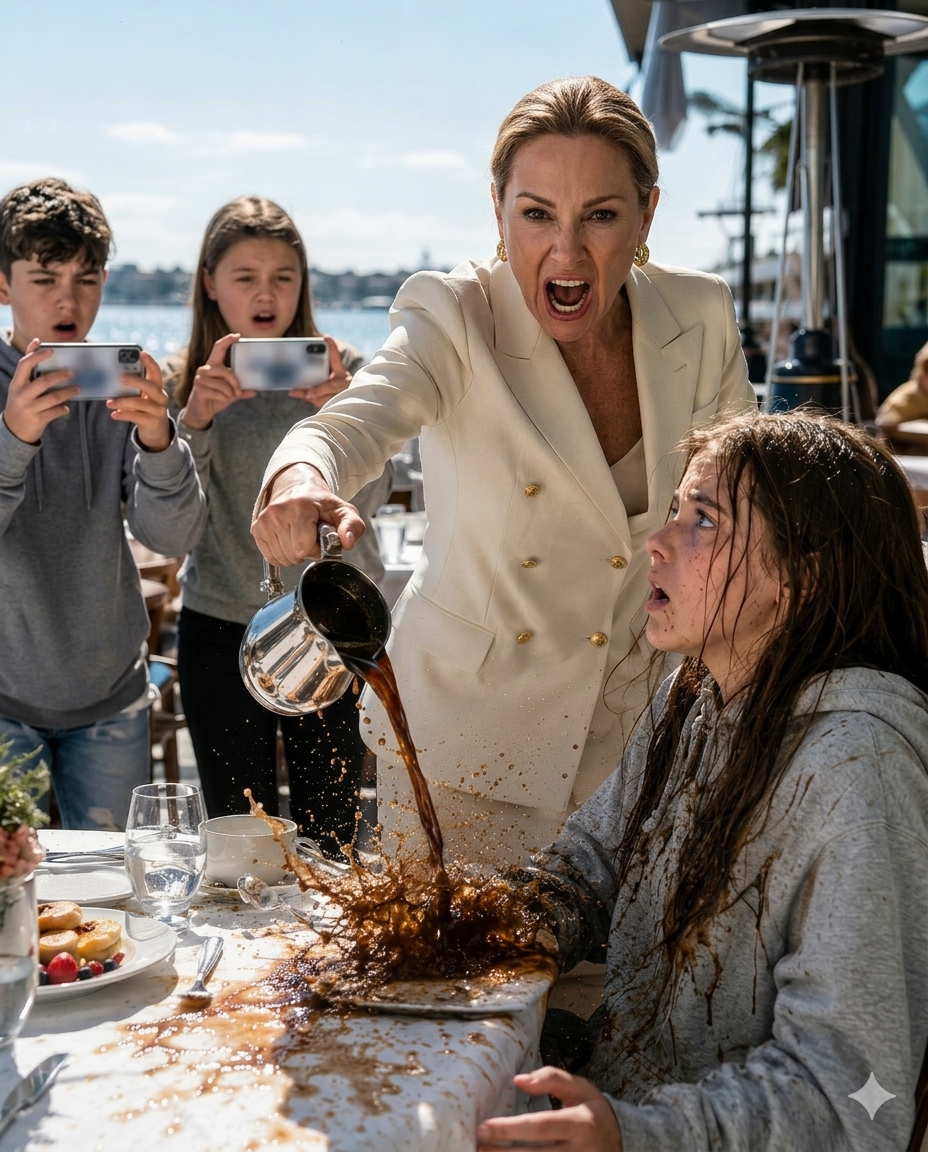
Contai quattro banconote da venti.
Ottanta dollari.
La mia parte per un brunch che non avevo nemmeno toccato.
Le uova e l’avocado toast che avevo ordinato erano ancora lì, ormai freddi e rappresi nel piatto. Il bicchiere di mimosa di Angela era mezzo vuoto. La caffettiera, dopo aver compiuto il suo crimine, riposava dov’era stata lasciata, con qualche ultima goccia raccolta nel beccuccio come un residuo di colpa.
Posai i soldi accanto alla caffettiera sulla tovaglia bianca.
Non li lanciai.
Non li accartocciai.
Li distesi uno per uno con cura, finché ogni banconota rimase perfettamente piatta. Per un istante il verde dei soldi, il marrone della macchia di caffè e il bianco della tovaglia formarono una specie di bandiera assurda, simbolo di tutto ciò che in quel momento era sbagliato e, allo stesso tempo, inevitabilmente giusto.
Sentivo addosso gli occhi di tutti e tre, insieme alla curiosità silenziosa degli estranei seduti nei tavoli vicini.
Nessuno parlò.
Perfetto.
Mi voltai lentamente dal tavolo.
«Esatto, scappa pure!» gridò Christopher alle mie spalle, con quella voce carica di trionfo teatrale. «Vai a piangere nel tuo camion, Emma.»
La mia mano si serrò intorno al portafoglio.
Continuai a camminare.
Non mi voltai.
Il loro silenzio mi seguì come un’ombra. Pesante. Denso. Non il silenzio che vive nel mezzo di una storia, ma quello che arriva alla fine di qualcosa.
Era il suono di una porta che si chiude.
Non con delicatezza.
Sbarrata. Blindata. Saldata per sempre.
Loro pensavano di avermi appena cacciata via. Di aver finalmente buttato la spazzatura fuori casa.
Non avevano la minima idea di aver appena registrato la propria condanna.
Outside the hotel, the winter air slapped my face. Chicago in December is not kind. The Sapphire’s heated terrace and fireplaces made it easy to forget that the city itself is capable of cutting through any coat, any pretense, at thirty miles an hour off the lake. My breath puffed out in little white clouds as I crossed the drive. Valets in neat black jackets flitted around polished cars, keys jangling, tires crunching over salt. My Subaru sat toward the back of the lot, under a bare tree. Ten years old. Faded blue. One scratch on the rear bumper from where I’d misjudged a parking post three winters ago. Paid off in full. No one looked twice at it. I liked that about it. As soon as I opened the driver’s door, the smell of stale takeout and coffee grounds in the cup holder wrapped around me. Today, there was a new top note of burnt coffee and singed hair. My hoodie squelched against the seat, leaving cool dampness seeping into the cracked fabric. I sat with my hands on the steering wheel and let the tremor roll through me. Not from fear. From adrenaline. The thing about surviving a moment like that isn’t the moment itself. It’s the crash afterward. The way your body, having sprinted through the fire, suddenly realizes you’re sitting still and decides to replay everything. My scalp throbbed in jagged pulses. Angela’s face as the coffee poured. Christopher’s laugh. Amanda’s phone held high. I saw it all again in the span of two heartbeats. I closed my eyes and forced my thoughts somewhere else. Back. To twenty minutes earlier. To when this had just been brunch. Angela had insisted on the Sapphire Hotel. Of course she had. “It’s where the board meets,” she’d said over the phone, voice dripping with self-satisfaction. “We’ll get a good table. Very visible. If the Art Council folks see us together, it’ll show… unity.” I hadn’t asked why my presence mattered to her image that day. It was already unusual enough for her to invite me anywhere public that wasn’t a holiday obligation. “Christopher has big news about his business,” she’d added. “And Amanda needs content. You can at least do that much, Emma. Show up.” At least do that much. I had been halfway through reviewing a pull request when she called. My cabin’s wood stove crackled quietly in the background; snow tapped softly at the windows. My dog, Pixel, snored on the rug by my feet. I could have said no. I almost did. But there’s a part of you, no matter how logically you know better, that still wants your mother to want you there. That still reaches for the Christmas-card version of family, the one with the matching sweaters and shared laughter. Besides, I told myself, I’d sold SafeMind three weeks ago. The ink was dry. The payout sitting in accounts so large they didn’t feel real yet. Maybe this brunch would be… different. Maybe we could talk like adults. Maybe I could come clean. Ha. The Sapphire had been Angela’s stomping grounds for years. She loved the terrace with its heated lamps and sweeping views of the lake. Loved that people saw her there, clinking glasses with board members and donors, air-kissing other women in cashmere coats. When I arrived, she’d already claimed a table near the railing. Her coat was draped just so over the back of her chair, label visible. Amanda sat to her right, scrolling on her phone. Christopher was pacing, thumb flying over his screen, checking whatever markets he pretended to care about that week. “Em,” he’d said when he saw me, flashing that salesman smile that used to get him out of trouble with teachers. “Look, she came.” “Hi, Mom,” I’d said, leaning in to brush my cheek against Angela’s. Her skin smelled like expensive moisturizer and cold disapproval. “You’re late,” she murmured, lips barely moving. “And what are you wearing? That hoodie looks… cheap.” “It was a last-minute invite,” I replied evenly, taking my seat. “Didn’t realize there was a dress code.” She pursed her lips, meaning: you should have known. Amanda gave me a once-over that felt like a TSA scan. “You could at least dress aspirational,” she said. “You know how lighting is here.” “She can’t afford aspirational,” Christopher joked, dropping back into his chair. “She lives in the woods, Mandy. Thrift stores and flannel is their runway.” “Cabin,” I corrected, reaching for my water. “And flannel is warm.” “Cabin,” Angela echoed, tasting the word like it was a cheap wine. “Honestly, Emma. You’re not a teenager at summer camp. You’re almost thirty. Don’t you ever think about… security? Stability? You could have moved back home after college like your brother and sister. Saved. Built a real life.” A real life. The waiter appeared then, and I clung to the interruption like a lifeline. Menus. Specials. Brunch cocktails. I ordered coffee and avocado toast without really listening. My scalp itched under my beanie—dry winter air—and I pushed it off, running a hand through my hair. That’s when Christopher leaned across the table. “Hey, so I’m glad you came,” he said, lowering his voice dramatically, like this was a movie and the plot was about to kick in. “I wanted to talk to you about an opportunity.” There it was. Not “How are you?” Not “I’m sorry I haven’t called since… ever.” An opportunity. “For you,” I said. “Or for me?” He laughed like I’d made a joke. “For both of us. Win-win. You know my dealership is doing crazy numbers, right?”