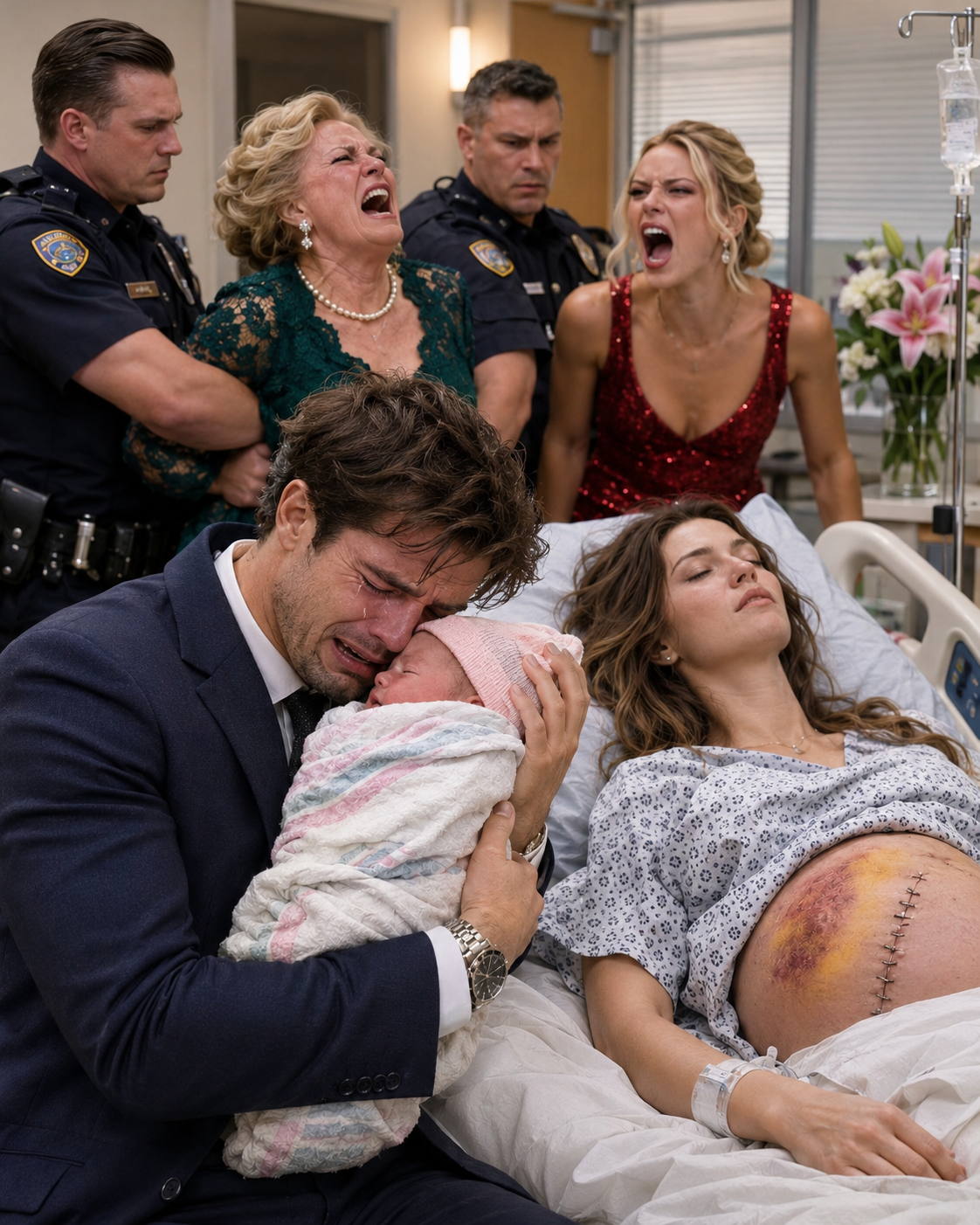
Cliffhanger: Le gomme del SUV di Dawson hanno squarciato l’asfalto bagnato mentre ero seduto sul sedile posteriore, stringendo la mia famiglia morente al petto, guardando i respiri superficiali di Jenna balbettare e svanire mentre il cartello dell’ospedale finalmente sanguinava rosso nella nebbia mattutina.
Chapter 4: The Triage of Truth
At exactly 5:42 AM, Mr. Dawson slammed his SUV into park directly across the ambulance bay of St. Jude’s Medical Center.
I kicked the door open and burst through the sliding glass doors of the emergency room, roaring for help. The intake nurse at the main desk took one look at Jenna’s slack, gray face hanging over my arm and slammed her palm down on a large red button beneath her desk.
Alarms instantly blared. The doors to the trauma bay flew open.
A swarm of personnel descended upon us. They ripped Jenna from my arms, transferring her to a gurney. I watched in paralyzed horror as a nurse shouted out vital signs that sounded like a foreign, terrifying language.
“Blood pressure fifty over palp! She’s profoundly hypotensive! Get a line in, push fluids, stat!”
Another nurse, wearing pediatric scrubs, snatched Wesley from the folds of my hoodie. She laid him on a warming table under a harsh, glaring spotlight. She swiftly fastened a plastic triage band around his minuscule, trembling ankle. With a thick black marker, she scrawled across a whiteboard hanging above him: 7 DAYS OLD — FEVER.
Seeing those words written in bold black ink made reality strike me with the force of a sledgehammer. My son was seven days old, and he was dying.
“My wife just gave birth,” I stammered, my voice cracking, repeating the phrase to anyone who would listen as they pushed me against the wall. “My baby is hot. He won’t cry anymore. Please. Please save them.”
A senior physician, Dr. Aris, stepped up to Wesley’s table. She stripped away his dirty diaper. The moment the fabric peeled back, revealing angry, blistering, raw skin covering his lower half, the atmosphere in the room shifted violently.
Dr. Aris didn’t look at it with the clinical detachment of a doctor diagnosing a disease. Her eyes darkened with the specific, furious recognition of a human being witnessing profound cruelty.
She turned slowly, her eyes locking onto my bloodshot gaze.
“Who,” she demanded, her voice deceptively quiet, “was caring for this infant and this woman at home?”
“My… my mother and my sister,” I answered, my teeth chattering as the adrenaline began to wear off, leaving me freezing in my soaked t-shirt. “I was away for work. Why? What’s wrong?”
Dr. Aris didn’t answer me. She turned to the charge nurse standing beside the crash cart. The doctor’s voice was absolute ice.
“Call the police. Tell them we have a critical pediatric neglect case and a maternal endangerment.”
The charge nurse didn’t hesitate. She immediately stepped between me and the exit doors, possessing the calm, unyielding authority of someone who had watched domestic tragedies unfold a hundred times before. She pointed at another nurse. “Get the camera. Photograph the blanket, the infant’s skin, and bag that diaper.”
Ten minutes later, the ER sliding doors parted again. Diane and Brooke rushed in, dramatically clutching their coats, their faces stained with theatrical tears.
But their performance was deeply flawed. Rather than running toward the triage desk to ask if Jenna was breathing, or if Wesley had survived, they immediately targeted me.
“Colin, oh my god, they practically kidnapped them!” Diane cried, grabbing my arm. “She was just having a tough recovery! You panicked!”
Brooke nodded frantically. “We were doing our absolute best, Colin. She wouldn’t let us help her!”
Dr. Aris stepped out from behind the trauma curtain. She looked at Diane, then at Brooke.
“Your best?” Dr. Aris repeated. The sheer, acidic disbelief in the doctor’s tone made both women physically recoil. “The mother has sepsis from an untreated postpartum infection and severe hypernatremia from catastrophic dehydration. The infant has a fever of 104.2 and early-stage renal distress because he hasn’t been fed in over twenty hours. That is your best?”
Diane’s mouth opened and closed silently.
A detective in a wrinkled brown suit pushed through the double doors, followed by two uniformed officers.
The charge nurse approached me, gently placing a hand on my shoulder. “Mr. Parker, do you have the discharge paperwork from the hospital?”
I panicked, realizing I had run out of the house barefoot. Then, Mr. Dawson stepped forward from the waiting area, holding the canvas diaper bag I had dropped in the hallway. He unzipped the front pocket and handed me the folder.
I handed it to the detective. I opened it to the third page.
There, circled in heavy blue ink, were the exact symptoms Jenna had been displaying for days. High fever. Lethargy. Inability to wake.