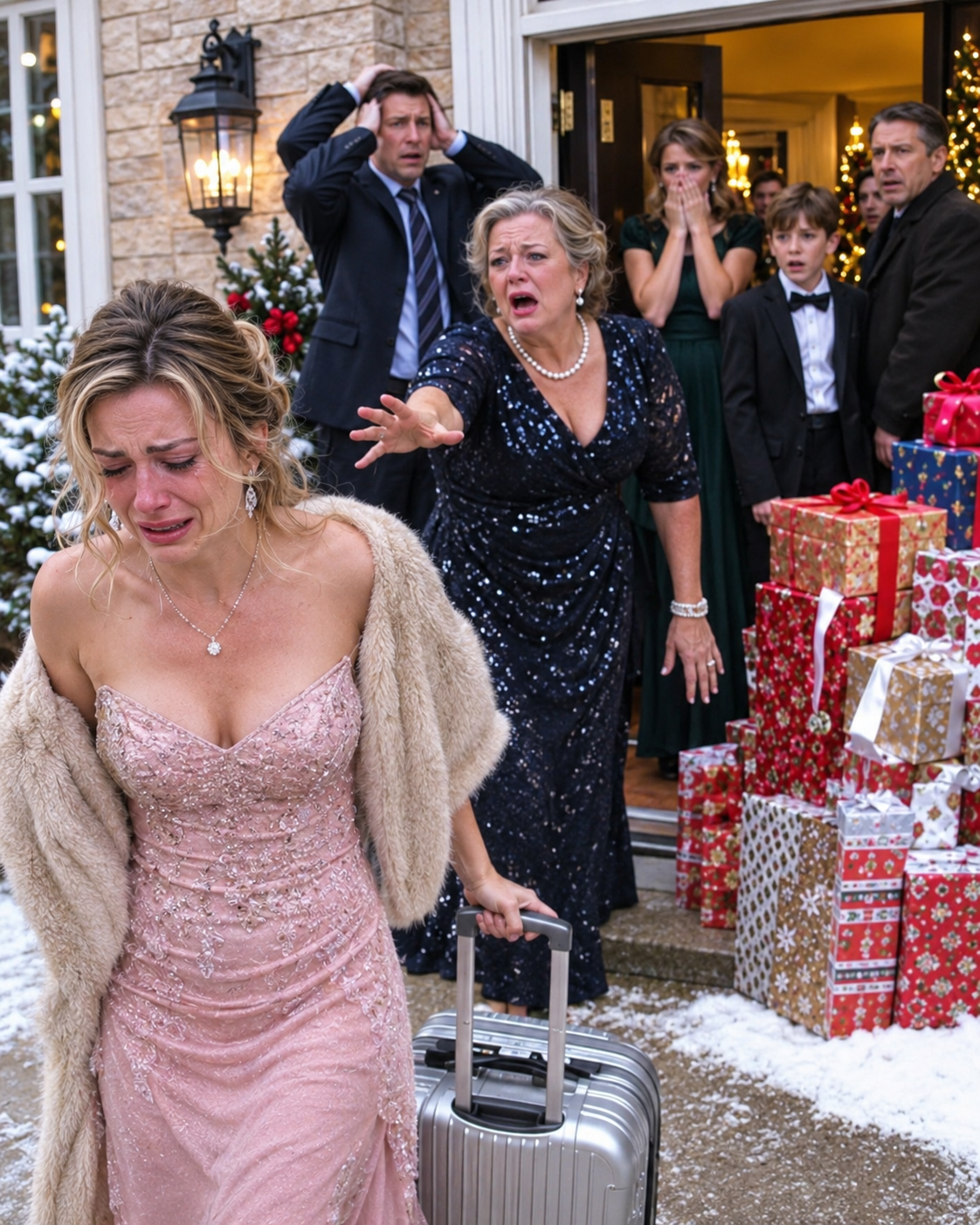
My father looked at me then.
Not with love.
Not with shame.
With betrayal.
“You did this behind our backs?”
I held his stare. “I saved this house behind your backs.”
The room went silent.
“You were supposed to lose it eight years ago,” I continued. “The bank had already started the process. You remember that week, don’t you? Mom cried for three days. Brent stopped answering calls. You told everyone you had handled it.”
My father’s nostrils flared.
“You didn’t handle it. I did.”
My mother lowered herself slowly back onto the sofa.
“I didn’t know,” she whispered.
“Yes, you did,” Thomas said.
Her head snapped toward him.
Thomas stepped forward, leaning slightly on his cane. “Maybe not about Northstar. But you knew Arthur’s story was a lie.”
My father’s voice dropped. “Careful.”
“No,” Thomas said. “I was careful when you forged my signature. I was careful when you emptied the business accounts and told the town I had disappeared with the money. I was careful when your lawyer threatened to bury me under lawsuits I couldn’t afford to fight. Careful cost me my company, my name, and my family.”
Brent frowned. “What is he talking about?”
For the first time all morning, my father looked afraid of his son.
Thomas reached into his coat and removed a sealed envelope. He placed it on the coffee table beside Evelyn’s documents.
“Your father didn’t lose the business because of me,” he said. “He lost it because he borrowed against contracts that didn’t exist. When the accounts collapsed, he needed someone to blame. I was convenient.”
“That’s a lie,” Brent said, but his voice had weakened.
Evelyn removed several photocopied bank statements from her folder. “It is not. Mr. Reed came forward last year after locating original files from the company’s former storage unit. Those files match records discovered among Celia Whitaker’s personal papers.”
At the mention of my grandmother, my mother shut her eyes.
Grandma Celia had been the only person in that family who loved without making people pay for it. She had taught me how to balance a checkbook when I was thirteen, how to make soup stretch through a hard week, and how to smile politely while refusing to be stepped on.
When she died, my father said she left nothing but old jewelry and debts.
That, too, had been a lie.
“She knew,” I said.
My father glared at me. “Your grandmother was confused near the end.”
“No,” I said. “She was careful near the end.”
Evelyn nodded. “Mrs. Celia Whitaker suspected that financial misconduct had occurred within Reed & Whitaker Construction. She also suspected Arthur Whitaker had used family assets to conceal personal losses. Before her death, she arranged for certain documents to be preserved. She instructed that they be reviewed only if Arthur attempted to take advantage of Claire or Claire’s children.”
Mia madre si coprì la bocca.
I looked at her. “Grandma knew you would protect him.”
Tears slid down my mother’s cheeks, but I did not move to comfort her.
That was another habit I had broken.
Brent threw the page onto the table. “So what? You want money? Is that what this is? You got your little revenge show. Congratulations.”
I stared at him for a long moment.
Last night, he had leaned back in his chair, smiling as Lucas tried not to cry, and said, “The world is easier when kids learn where they rank.”
So I answered him with his own lesson.
“No, Brent. I want you to learn where you rank when nobody is paying your way.”
His face hardened. “You think you’re better than me?”
“No. I think I stopped asking you to be better, and that made me free.”
My father slammed his hand against the fireplace mantel. “Enough. I will not be lectured in my own home by an ungrateful daughter.”
Thomas looked at him coldly. “It stopped being only your home the day she paid to keep it standing.”
My father pointed at him. “You don’t get to speak about my daughter.”
Something shifted in Thomas’s expression.
It was small. Almost invisible.
But I saw it.
So did my mother.
She stood suddenly. “Thomas, don’t.”
The room froze.
My skin prickled beneath my coat.
Thomas did not look at my mother. He looked at me.
Evelyn closed her folder halfway, as if she had expected this moment but hoped it would come later.
“What does that mean?” I asked.
My mother’s face collapsed into panic. “Nothing. Claire, please. This is already enough for one day.”
I turned to my father.
He would not meet my eyes.
For thirty-six years, Arthur Whitaker had met every accusation with anger. He shouted over bills, over apologies, over truth itself. Anger was his wall.
But now, for the first time in my life, he was silent.
Thomas reached into his coat again.
This time, he removed a small cream envelope, old enough that the edges had yellowed. My name was written across the front in my grandmother’s careful handwriting.